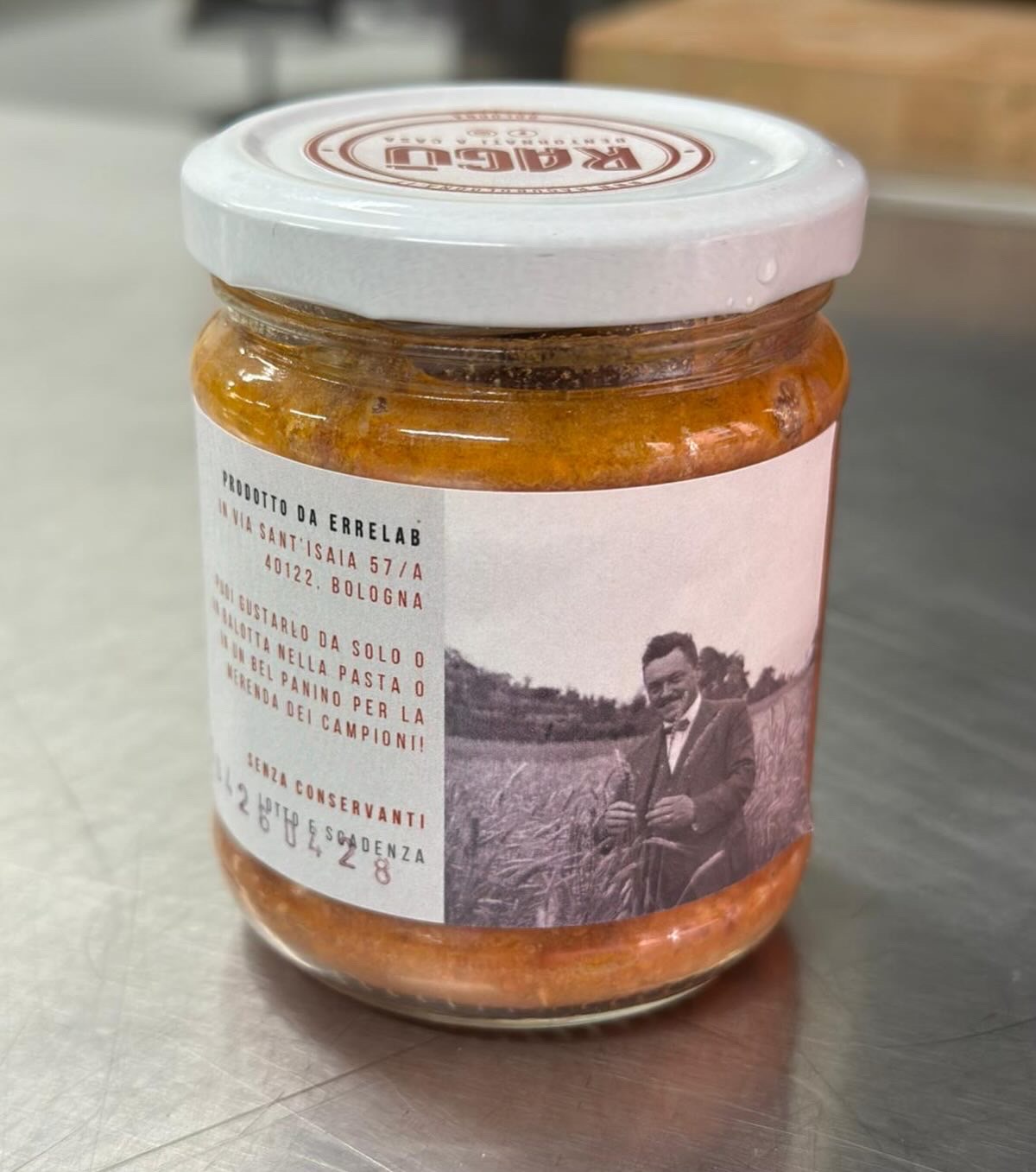
 The traditional-recipe ragù is Ragū Bologna’s signature sauce. It means looking for something more than a meat sauce. It was our attempt to think about how a homemade ragù could really have been made back in the late 1800s when certain tools were still missing and, above all, you used whatever meat was available, because there wasn’t enough money to buy the “good” stuff.
Traditional-recipe ragù in our Bologna: what it really means
The idea of a “traditional recipe” can be misleading. Bolognese ragù is not a museum artifact, unchanged for centuries. It’s an urban preparation that has been refined in home kitchens, trattorias, and fresh pasta workshops. It has gone through different meat availabilities, family habits, and seasons, while maintaining a clear direction: building an intense, full-bodied sauce that’s never overpowering.
The starting point remains the soffritto: celery, carrot, and onion worked slowly in fat until their aroma becomes sweet and deep. They shouldn’t stay crunchy or disappear in a burnt shortcut. They’re the foundation on which the meat can cook properly, developing flavor without becoming heavy.
Then comes the meat, browned carefully. We cut it by knife and it’s essential to the result: it gives substance, structure, and fills each bite. The heat can’t be too aggressive, but not too weak either—it needs to be lively. You need heat, but you need judgment. Ragù isn’t born from haste.
Here’s one of the most important differences between our traditional-recipe ragù and traditional ragù: the tomato. We only use tomato paste, not passata. It enters as a supporting element, not as the absolute star. It holds the base together, adds roundness, and supports a long cooking time. As in our traditional version, we don’t add milk. This makes it lighter and more digestible, as well as suitable for practically everyone.
Meat Cuts
The difference seems small, but on the palate it’s clear. Our cuts include beef tongue for sweetness, chicken livers to cut through with a more decisive taste and slight bitterness, beef rib cap to make everything more buttery so the meat melts in your mouth delivering an intense but tasty flavor, and finally beef tripe to provide a low-fat, high-protein ingredient that gives a slightly herbaceous yet neutral flavor, and pancetta for punch and savoriness.
Ingredients matter, but how you treat them matters more: Errelab.
Everything is done with care by the skilled hands of our team at via Sant’Isaia 57, a tucked-away area, far from prying eyes, in the center of Bologna. Selected meats that give structure and flavor to our dishes. But buying excellent ingredients isn’t enough to make excellent ragù.
The real difference lies in the less spectacular steps: cutting the soffritto evenly, letting the wine evaporate, stirring when needed and not out of anxiety, controlling moisture, adding liquid a little at a time. These are simple gestures, repeated with precision.
Even the fat deserves respect. Some versions use pancetta to give punch and savoriness, others prefer a lighter touch. It’s not a contest over who adds more ingredients. The useful question is different: does that detail help the ragù be more balanced? If yes, it makes sense. If it covers everything else, it’s just noise.
Slow cooking isn’t a romantic detail
Saying “slow cooking” is easy. Doing it well means understanding what happens in the pot. At first the flavors are separate: the vegetables, the meat, the acidity of the tomato, the dairy component. Over time they merge. The liquid reduces, the fat integrates, the meat becomes more tender, and the aroma changes register.
Too lively a flame compromises this work. Too timid cooking, on the other hand, can leave a pale, underdeveloped ragù. The pot needs to simmer steadily. Every so often you check, stir, taste. There are no reliable shortcuts, only experience and care.
The right pasta: tagliatelle, lasagne, and more
Bolognese ragù needs pasta that knows how to welcome it. Fresh tagliatelle is the most natural pairing: wide, porous, elastic, with a sheet that holds the sauce with every forkful. No need to drown it. A well-measured amount lets you taste pasta and ragù together, without one canceling out the other.
In lasagne the ragù works differently. It enters into dialogue with béchamel, pasta sheets, and cheese, helping to build layers that are soft but defined. Here too a simple rule applies: abundance doesn’t mean balance. Ragù that’s too liquid floods the layers; one that’s excessively dry makes the result compact and heavy.
The habit of serving ragù with spaghetti is common outside Emilia-Romagna, but it’s not the pairing that best tells the Bolognese tradition. Smooth, thin spaghetti often leaves the sauce on the plate. Fresh pasta sheets, on the other hand, give it a home. Less postcard folklore, more taste logic.
How to recognize well-made ragù even for takeout
Ragù can travel well, as long as it’s prepared and packaged properly. In fact, after a brief rest the flavors are often even more blended. For those who want to take Bologna home in a container or jar, quality can be recognized by concrete signs.
The aroma should recall slowly cooked meat and aromatic base, not just tomato or spices. The color is warm and natural, never artificially bright. The consistency should be full-bodied, with a clear presence of meat and without excessive separation of water or fat. On the palate, the first sensation should be balance: savory, round, persistent, but clean.
At Ragù Bologna the preparation starts in the kitchen, from handmade pasta sheets to sauces. It’s a very simple principle: takeout can be quick, but it shouldn’t taste rushed. A well-made plate of tagliatelle al ragù remains a real meal even between a class, a work shift, and a walk under the porticos.
Reheating it at home without ruining it
If the ragù is already prepared, heat should be managed gently. Better to warm it in a small pot over low heat, adding a spoonful of hot water if needed. The microwave can be practical, but should be used in short intervals, stirring between each round, to avoid hot spots and cold areas.
With fresh pasta, the decisive step is tossing. Cook the tagliatelle in well-salted water, drain them while still elastic, and toss them for a few moments with the ragù. If needed, add a little pasta cooking water. Not to stretch the sauce, but to make it adhere to the pasta sheet. Grated cheese comes at the end, to taste, without turning everything into a heavy blanket.
Tradition doesn’t mean immobility
Defending Bolognese ragù doesn’t mean treating it like a dogma useful only for correcting others. It means knowing why certain choices work and not confusing a well-constructed version with any red sauce called “bolognese.” Tradition lives when it remains readable: when you recognize the soffritto, the meat, the slow transformation of cooking, the relationship with fresh pasta.
There are legitimate personal variations and there are compromises that completely change the dish. Reducing cooking time may be necessary in a busy home kitchen, but the result will be different. Increasing the tomato may be pleasing, but it shifts the ragù toward another family of sauces. It’s not forbidden: just call things by their name.
Next time you open a jar of ragù or choose a plate of tagliatelle, take an extra minute. Look at the consistency, smell the aroma, taste before adding anything else. The best ragù doesn’t ask for special effects: it asks for good pasta sheets, a fork, and the time to enjoy it.