 ERRELAB is our fresh pasta and sauce workshop where we produce all our products.
In Bologna, fresh pasta isn’t a side dish for sauce. It’s the starting point for everything: a well-rolled sfoglia, a balanced filling, a sauce that reaches the plate hot and unhurried. Looking for fresh pasta in Bologna means looking for exactly this: not just any pasta, but a preparation made with skill, measure, and respect for the city.
A cutting board, a rolling pin, eggs, and flour. It seems simple, but just change the dough’s moisture, the thickness of the sfoglia, or the resting time, and you change the result. The difference is felt in the first bite: in the texture, the aroma, the way the ragù clings to the pasta instead of sliding off.
Fresh Pasta in Bologna: How to Recognize It
Well-made pasta shouldn’t be perfect like an industrial product. It can have a slight variation in thickness, the mark of handwork, one edge less identical to the other. What matters is something else: elasticity, how it holds up in cooking, and its ability to embrace the sauce.
In Bolognese tradition, sfoglia is born primarily from the meeting of flour and eggs. The proportion isn’t a formula to repeat blindly, because eggs aren’t all the same and flour changes with the seasons. Those who truly work the dough understand it through their fingers: whether it needs more flour, if the mass is too dry, if it needs to rest longer.
Then comes the rolling pin. Rolling the sfoglia by hand requires constant pressure and attention. Too thick, it stays heavy. Too thin, it risks breaking or losing structure in the pot. Tagliatelle needs a sfoglia that maintains character, while tortellini and tortelloni demand precision in the discs, the sealing, and managing the filling.
Freshness, however, doesn’t just mean recent production. It means pasta stored and cooked with care. An excellent sfoglia can be ruined by distracted cooking, undersalted water, or a few minutes too long. Fresh pasta cooks quickly: it needs to be watched, tasted, drained when it’s ready to finish its work in the sauce.
Not Every Sfoglia Calls for the Same Sauce
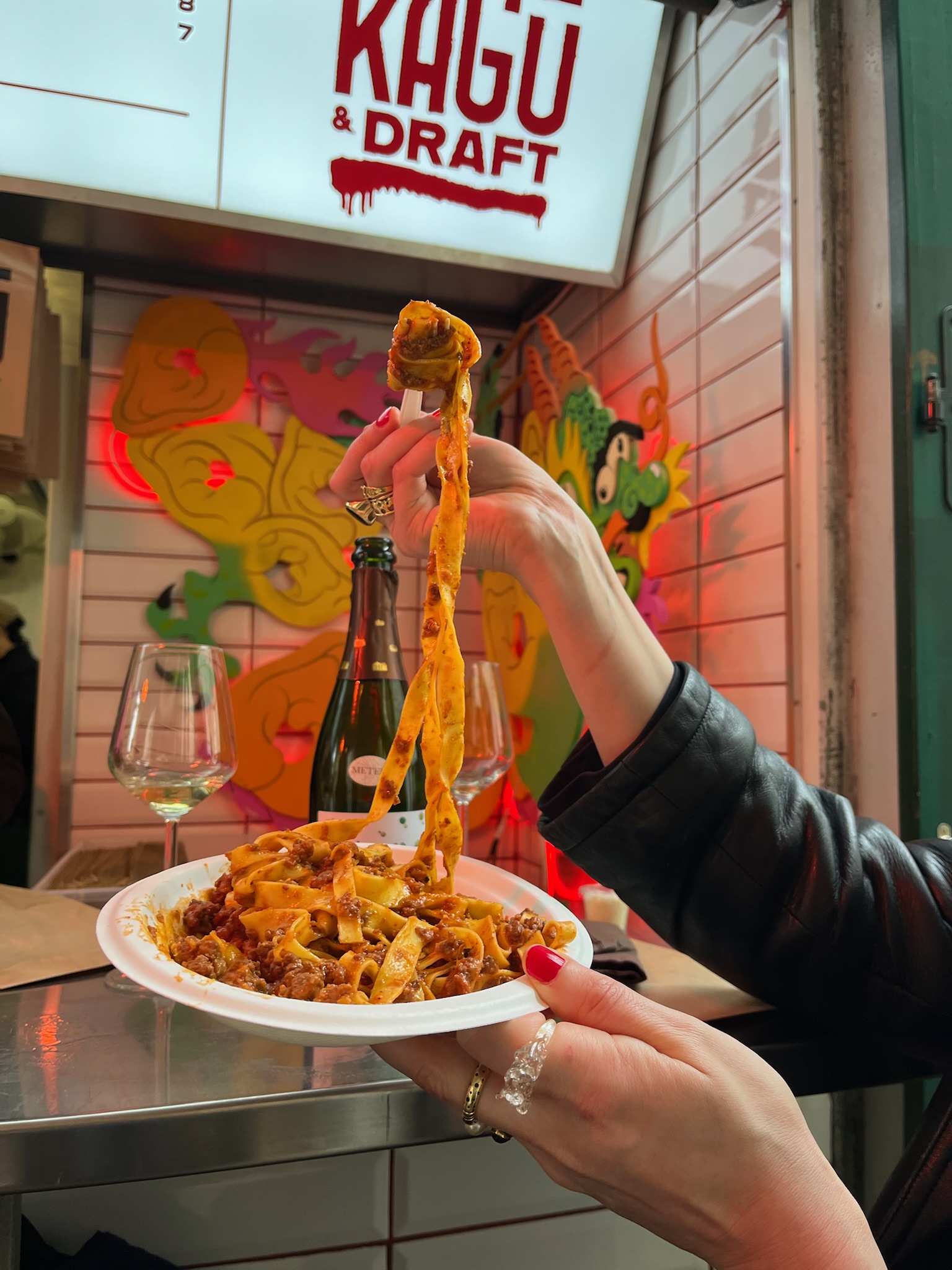
In Bologna, shapes have meaning. They’re not decoration for the menu, but a precise choice between texture, filling, and sauce. Tagliatelle has a wide, porous surface, made to gather a rich ragù without being drowned by it. The result shouldn’t be a mountain of sauce: the ragù should accompany the pasta, enter its folds, leave the sfoglia itself recognizable.
Tortellini follow a different logic. Small, sealed one by one, they concentrate a savory and complex filling. They’re tied to broth, because that’s where their balance expresses itself most clearly. The broth doesn’t serve to cover: it serves to support, keep warm, and bring to the palate the depth of meat and cheese.
Tortelloni, more generous in form, call instead for soft fillings and less invasive sauces. Ricotta, greens, and butter may seem simple, but here simplicity is demanding. If an ingredient is weak or poorly measured, there’s nothing to hide it behind.
And then there are lasagne, where the sfoglia must work as a team with ragù, béchamel, and cheese. Layers too thick become heavy, layers too thin disappear. A well-made lasagna stays compact when cut but not dry, hot all the way to the center and generous without becoming excessive.
Ragù Is Not a Shortcut
Fresh pasta deserves a sauce prepared with the same patience. In Bolognese ragù, time is a real ingredient: the meat must cook slowly, the aromas must blend, the sauce must become dense and deep without reducing to an indistinct cream.
There are many family versions, many kitchen habits, many legitimate debates. Tradition isn’t a glass case. But there are clear boundaries: Bolognese ragù is not a tomato sauce with ground meat added at the last minute, nor a condiment to use indiscriminately on every pasta shape.
The point isn’t chasing some supposed postcard purity. The point is recognizing balance. A good ragù brings savoriness, the natural sweetness of vegetables, depth of meat, and a texture that coats. If it completely covers the taste of the sfoglia, something is lost. If it’s too liquid, it doesn’t bind. If it’s too fatty, it tires quickly.
That’s why tagliatelle al ragù remains such a difficult dish to improvise. It has few elements, all exposed. It’s not enough to call it traditional: it must be so in the work.
What to Expect from Fresh Pasta Takeaway
Fresh pasta doesn’t have to stay confined to Sunday or the restaurant with long tablecloths. In Bologna it can also be a lunch break, a dinner brought home, something to eat with company after a full day. Takeaway done right doesn’t reduce the dish to a quick solution: it simply changes the context in which you eat it.
Here, management matters. The portion must arrive hot, the container must protect the pasta without turning it into a soggy mass, the sauce must be measured to hold up through a few minutes of waiting. Not all preparations travel the same way. Tagliatelle al ragù is reliable if prepared and packaged with care; tortellini in broth need intelligent separation between pasta and liquid; lasagne requires uniform temperature.
Even at home, two minutes make a difference. If the dish needs reheating, better to do it gradually than attack it. If the sauce seems compact, a gentle pass restores softness. And if you choose filled pasta, don’t load it with extra cheese or sauces: taste it first. A well-made filling already has its own voice.
Living Tradition, Not Fake Nostalgia
Bolognese cuisine doesn’t need to dress up as a souvenir. It needs to be made with recognizable ingredients, precise gestures, and a bit of pride. This applies to those who live in the city and want a serious lunch, to students looking for something better than the usual sandwich, to those visiting Bologna who prefer to taste a real dish instead of chasing a trend.
Modernity isn’t putting an English name on an ancient recipe. It can be making artisanal cooking accessible, serving it in reasonable time, pairing it with a thoughtfully made drink, and reducing waste where possible. At Ragù Bologna, the sfoglia, sauces, and bread are made in-house precisely for this reason: less special effects, more substance.
There’s also room to choose according to the moment. A portion of tagliatelle al ragù is a direct and reassuring classic. Tortellini are the right choice when you want the most recognizable flavor of tradition. Tortelloni speak to those who prefer a more delicate softness. Lasagne is for when you need a dish that truly tastes like home cooking, even if home is on the other side of the city.
Next time you’re short on time, don’t settle for a dish that just fills you up. Look for a sfoglia that holds its bite, a ragù that’s had its time, and a flavor that doesn’t need filters. Welcome home.