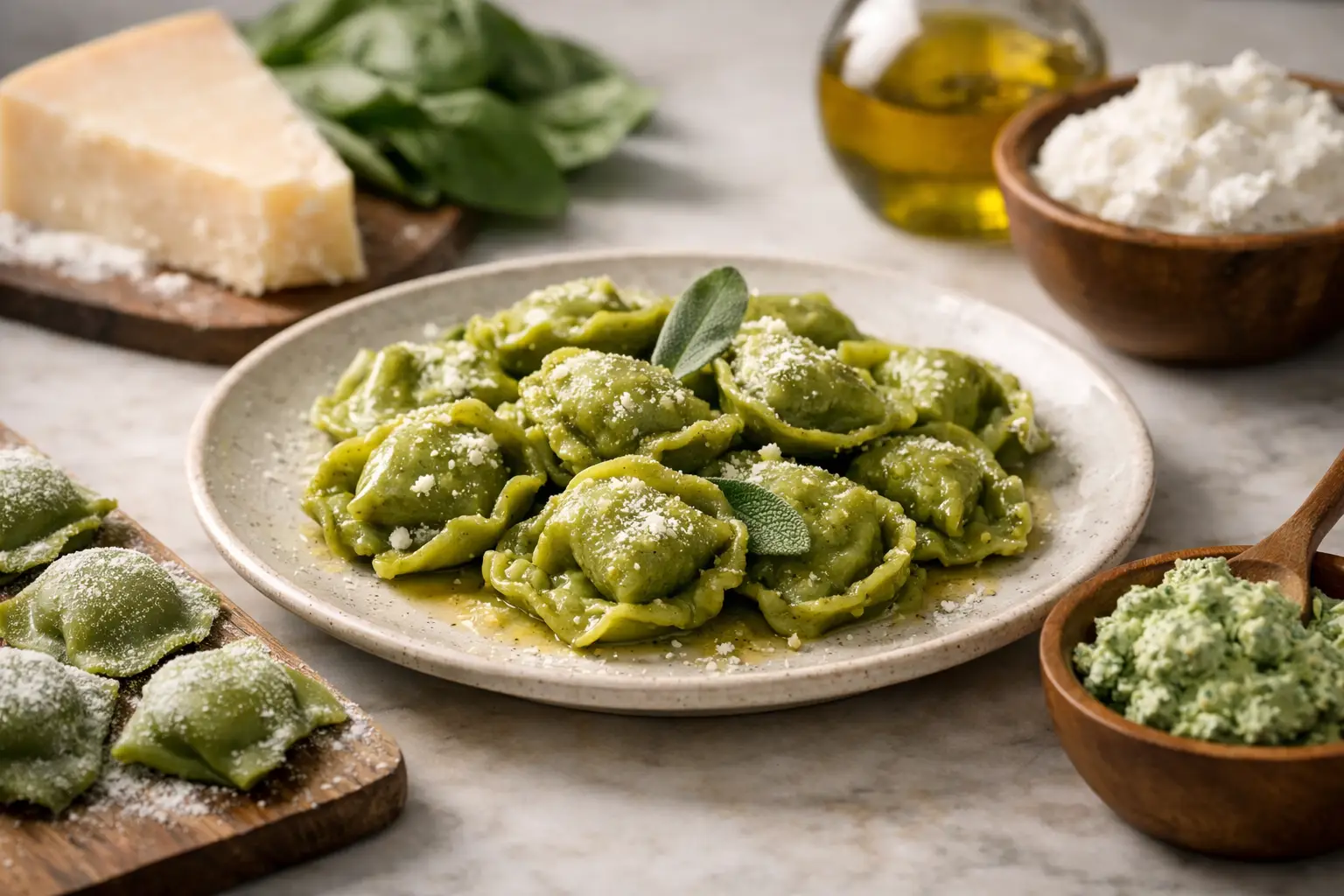
 Balanzoni are not a shortcut in the Bolognese repertoire. They are generous filled pasta, green in dough and full of character: a dish that calls for good ingredients, skilled hands, and the desire to eat slowly. In a city that often talks about tortellini and tagliatelle al ragù, they deserve a precise place at the table.
What Are Balanzoni
Balanzoni are a fresh filled pasta from Bolognese tradition, recognizable even before the first bite. The green dough, traditionally made with spinach, holds a soft and flavorful filling in which ricotta, mortadella, Parmigiano Reggiano, and eggs find a very Emilian balance: dairy, cured meat, aged cheese, and pasta-making craft.
The shape often resembles a large tortellone, sealed in a half-moon or with folded edges. There is no single mandatory fold, because home cooking has never needed uniforms. What cannot be missing is proportion: enough dough to hold the filling, but not so much as to cover its flavor.
Their name recalls Balanzone, the Bolognese mask from Commedia dell’Arte. Pompous doctor, full belly, abundant speech: a perfect reference for a pasta that does not try to be minimal. Balanzoni arrive on the plate without making a scene, but they do not go unnoticed.
A Tradition That Leaves Room for Variations
As with many local dishes, claiming a single recipe for balanzoni would be dishonest. Proportions change between families, sfogline, and professional kitchens. Some prefer a drier ricotta, some increase the Parmigiano for a more assertive filling, some use mortadella with a light hand and others make it the star.
The origin is often traced back to 20th-century Bologna and the desire to create a green, festive, and recognizable filled pasta. But in the kitchen what matters most is what the dish continues to say today: local ingredients, intelligent recovery of traditional knowledge, and no need for special effects. Less posing, more substance.
The Green Dough Is Not a Detail
In balanzoni, the green is identity, not decoration. The spinach must be cooked, carefully squeezed, and finely chopped before entering the dough with flour and eggs. If it releases too much water, the dough becomes difficult to roll out and risks breaking during cooking. If there is too little, the color remains timid and the flavor disappears.
A good green dough must be elastic, thin, and resistant. These are three qualities that must coexist. Rolling it too thick leads to a heavy bite, especially with such a rich filling. Rolling it too thin can make it give way in boiling water. The sfoglina’s hand serves precisely this purpose: understanding the dough by touch, not just following a number written in a notebook.
The color can vary from bright green to a darker shade. It is not an automatic defect. It depends on the spinach, its moisture, and the resting of the dough. Seeking an artificially bright green would be a mistake: here you are not eating a photograph.
The Filling: Rich, but Never Confused
The heart of balanzoni is balance. Ricotta, mortadella, and Parmigiano Reggiano are intense ingredients, but they must speak to each other without overpowering one another. Fresh, well-drained ricotta gives creaminess; mortadella brings aroma and roundness; Parmigiano Reggiano adds savory depth. The egg binds the mixture, while nutmeg and pepper can complete it with discretion.
The most common risk is a filling that is too wet. In that case the seal does not hold, water gets in, and the pasta falls apart. The other risk is the opposite: a dry, compact, almost dry and dense mixture. The right filling must remain soft after cooking and have a full consistency, not mushy.
Mortadella deserves a separate note. It must be chosen well and worked carefully, without turning it into an indistinct cream. It must be present in the aroma and flavor, not become the only voice of the dish. In balanzoni, richness does not come from accumulation: it comes from harmony.
The Size Changes How You Eat Them
A large balanzone can be satisfying, but it requires flawless dough and precise cooking. Smaller pieces are convenient to serve and easier to manage, especially when the dish needs to travel or arrive home still at the right point. It is not a question of the best size in absolute terms. It depends on the occasion, the sauce, and how much filling you want to taste in each forkful.
For a quick lunch, a well-calibrated portion avoids that heaviness often attributed to filled pasta without reason. For a family dinner or a holiday table, however, the more generous balanzone has every right to take up space.
How to Dress Balanzoni Without Covering Them
The most natural dressing is melted butter and sage. It is simple only in appearance: the butter must be fragrant without browning too much, the sage must release aroma without becoming bitter. A sprinkle of Parmigiano Reggiano at the end completes the dish and leaves the filling in the leading role.
A light Parmigiano cream can also work, especially if the dough is thin and the filling has delicate mortadella. Here caution is necessary: a sauce that is too thick or too salty flattens everything. Balanzoni already have their own voice, they do not need a megaphone.
Bolognese ragù, as beloved as it is, is not always the most suitable choice. It can be a delicious variation, but it shifts the center of gravity of the dish and tends to cover the ricotta and the green of the dough. If you want to try it, better a well-balanced ragù, not overly concentrated, and a measured amount. Tradition is not fragile, but it must be treated with respect.
Cooking and Serving: A Few Minutes That Count
Fresh balanzoni should be plunged into plenty of salted water that simmers steadily. Too aggressive a boil can open the seals and knock the pasta against the pot. When they rise to the surface it does not always mean they are ready: the time depends on the thickness of the dough and the size of the format.
They should be drained gently, better with a slotted spoon than with abrupt movements, and immediately tossed in the sauce. Waiting too long makes them dull and dries out the surface. Filled pasta does not like unnecessary pauses.
At home, the advice is the same as for any good fresh takeout pasta: organize plates, sauce, and water beforehand. Do not leave the package on the table while deciding what to do. The work of the kitchen reaches the door, then the final minutes are in the hands of whoever serves.
Why Balanzoni Still Speak of Bologna
Balanzoni tell a less stereotypical but deeply true Bologna. There is hand-rolled dough, spinach, mortadella, Parmigiano Reggiano, and that Emilian ability to transform concrete ingredients into a dish that feels festive without becoming pretentious.
For those who live in the city, they are a way to change from the usual lunch without giving up something done well. For those who visit, they are a choice that goes beyond the most photographed dish. At Ragù Bologna we believe that local cuisine should remain everyday, accessible, and precise: tradition matters when it truly ends up on the fork.
Next time you are looking for a full Bolognese flavor, look beyond the sauce and start with the dough. If it is green, thin, and holds a filling made properly, you are already on the right track.